
What is electronic leveling? See how Volumetric runs this process
At Volumetric, electronic leveling is run by our team directly on your machine, and the raw reading is processed by the VCS (Volumetric Calibration System), our in-house diagnostic tool. Based on the real measurement data, the VCS:
- Reconstructs the leveling map along the entire way
- Calculates transverse and longitudinal twist at each measured point
- Points out exactly which support or shim needs adjustment, and in which direction
- Indicates when the deviation is within what the machine manufacturer considers acceptable
The result is the exact point of mechanical adjustment, not a generic recommendation to "level the machine," with a real source behind every reference value: manufacturer manual or validated technical documentation.
Errors leveling reveals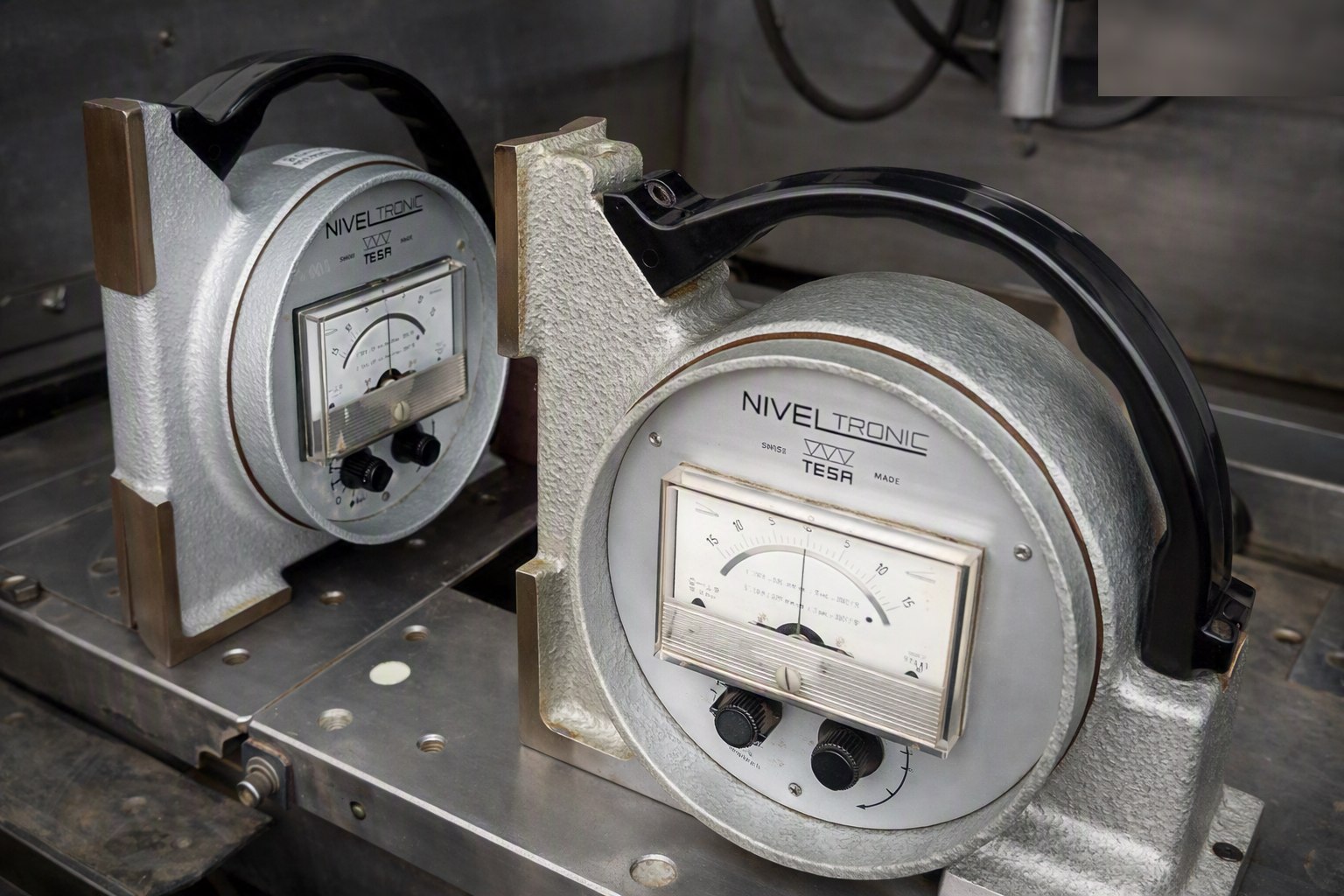
What is electronic leveling +
Electronic leveling uses a high-resolution electronic level, far more sensitive than a common bubble level, to measure, point by point, the real tilt of the ways and guideways that support the machine's axes. The instrument is positioned at defined points along the way, and each reading records how much that point deviates from the machine's reference plane.
There are two main formats. The single-precision level, like the Niveltronic (Tesa), has a cast-iron body and a stable zero point, which matters for aligning large parts without the zero "drifting" during measurement. The differential level, like Mahr's, uses two pendulum-type heads (clinometers) and an electronic amplifier, allowing two points on the way to be compared directly, with the scale already calibrated in arc-seconds.
Instrument specifications +
Manufacturers' own numbers, for technical reference:
The result is a real leveling map of the machine's base: not a visual guess that "it looks level," but the measured value at every point.
How absolute zero is determined +
A high-precision electronic level doesn't rely on a fixed mechanical zero. It reaches absolute zero through a reversal measurement: the instrument is positioned on a point and a first reading is taken; it's then rotated 180° at exactly the same spot and support, and a second reading is taken. Averaging the two readings cancels out the instrument's own zero drift and isolates the surface's real tilt, independent of any sensor calibration error. It's this technique, not the assumption that the instrument "already reads zero," that lets electronic leveling be used as an absolute reference, rather than just a relative comparison between two points on the way.
Why the base's geometry matters +
A CNC machine's axes are built on top of its ways. If that base has twist (one point higher on one side, lower on the other), that distortion propagates upward into every axis movement, even if the control is perfectly parameterized.
It's a type of error that a circularity or interferometry test, run in isolation with the machine sitting on a twisted base, can't always clearly separate from the real cause. That's why leveling is usually the first step, before the other tests, not after.
What each deviation indicates +
Each of these deviations has a different origin, and the point-by-point leveling map helps identify exactly which support needs adjustment, instead of leveling the entire machine by trial and error.
What the measurement doesn't do on its own +
Electronic leveling measures the deviation. It doesn't correct anything on its own: the correction is mechanical, done by adjusting the machine's shims or leveling feet, following the manufacturer's leveling procedure. Unlike an axis error, way twist isn't solved with a compensation parameter in the control.
When it's worth doing the leveling +
Electronic leveling is typically recommended:
- At installation of a new machine, before any other geometry test
- After relocation or reinstallation of the machine
- When the floor or foundation may have settled unevenly over time
- Before running a Ballbar or interferometry test, when the base is suspected of not being level
- As part of periodic preventive maintenance, especially on large machines
An out-of-level base doesn't show up on its own on the control panel: it shows up as an error the other tests, taken in isolation, can't explain.
A quick video showing how we identify and correct this type of error, right on the machine.